ABA Media Platform | AMP

Your master passed. Then it came back.

AudioVibes — the measurement tool. One of two doors into ABA Media Platform, a one-person media studio in Greeley, Colorado. The other door is the production process behind it.

Analyze a master.

Why it matters

The platform rejected it, or the client heard something you did not, or the reference sounded bigger at the same loudness and nobody could say why.

You can measure your way out of that. What you usually cannot do is find out which measurement, against what target, and where the target came from — because most tools hand back a verdict and keep the arithmetic.

This one shows the arithmetic. Drop a file in and read it yourself.

No account, no wait. It runs here, in this page, on your machine.

The ABA Toolbox Repair Book

Found something? The Repair Book shows you the most likely fix.

One page for every finding the tool can return that isn't a pass: what it sounds like, why it happens, the fix step by step, and how to check it worked. Read four pages free, or get all twenty-nine.

See the Repair Book →

What you get back

Findings, each with its own receipt.

Measured to published standards

Loudness and true peak are computed to ITU-R BS.1770-4 (true peak with the Annex 2 oversampling filter) and EBU R128; loudness range to EBU Tech 3342. The loudness is checked against an independent implementation, pyloudnorm, and agrees to within 0.05 LUFS. Build 2026-10-15.1 passes the EBU Tech 3341/3342 minimum-requirements test set, 29 of 29.

Four readings are ABA's own measurements, with no standard behind them: stereo correlation (how closely left and right move together, from -1 to 1), spectral tilt (how the level falls across the octaves, in dB per octave), clipping (runs of three or more samples in a row at or within about 0.05 dB of full scale), and DC offset (the average departure from zero).

A score that admits what it is

The score weighs those measurements against genre profiles, and those profiles are declared heuristics rather than evidence. We say so on its own page instead of burying it.

An argument you can have

Each finding names the measurement, the target, and why the difference matters. Disagree with a target and you know exactly which number to argue with.

A result, measured the night it happened

The same file. Three questions. Three answers.

A master is not good or bad in the abstract. It is good for somewhere. On 27 and 28 September 2026 one master of Cosmic Honey — the “radio ready” version of 31 August, made with an AI mastering tool — went through AudioVibes three times.

Its measurements did not change across the three runs: −8.37 LUFS integrated, −0.86 dBTP true peak, 2.73 LU loudness range. Only the question asked of it did.

Genre profileDelivery targetScoreWhat decided it
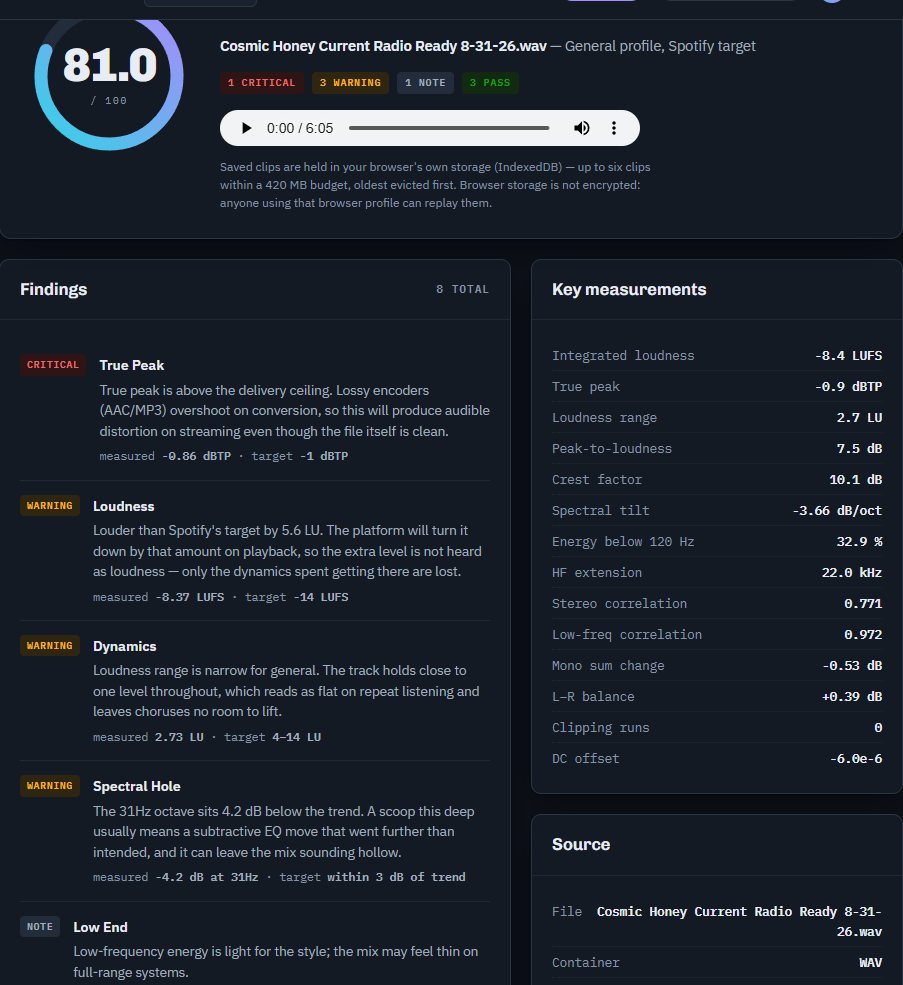
GeneralSpotify81.0 5.6 LU louder than Spotify’s −14, so the platform turns it down; true peak over the −1 dBTP ceiling.
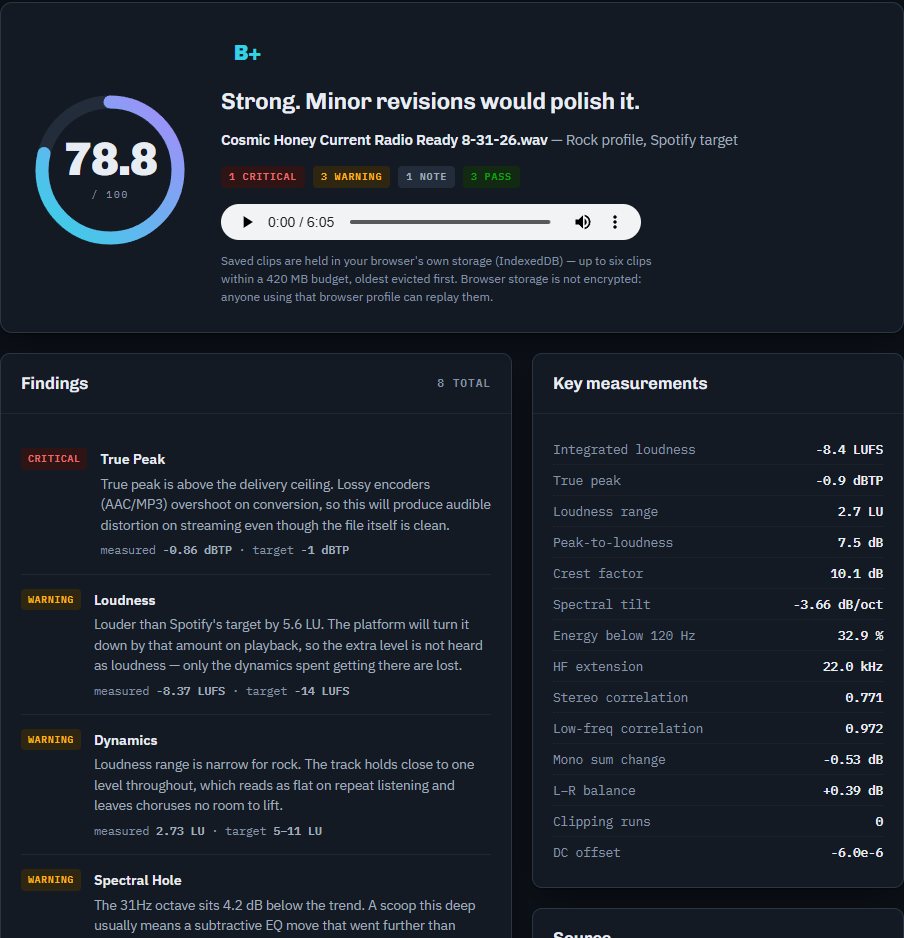
RockSpotify78.8 The same, and rock asks for more movement: 5–11 LU against the file’s 2.73.
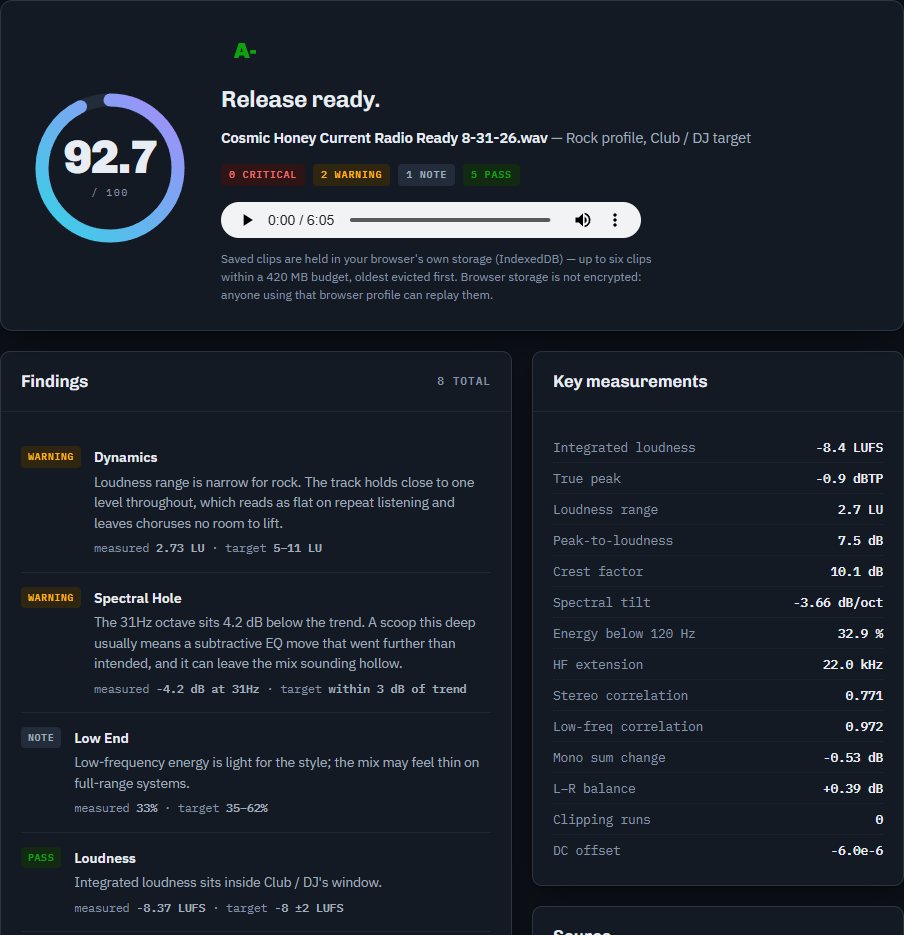
RockClub / DJ92.7 Loudness and true peak both inside the club window. Release ready.
AudioVibes report: Cosmic Honey Current Radio Ready 8-31-26, general profile, Spotify target, scored 81.0 with one critical true-peak finding and a loudness warning.
The same file on the rock profile with the Spotify target, scored 78.8. The measurements are identical; the dynamics target is wider.
The same file on the rock profile with the Club / DJ target, scored 92.7, release ready, with no critical findings and loudness passing.

Crops of the three saved reports, left to right in the order of the table. Select one to open it full size.

The loudness was right for the club and wrong for streaming. The flat dynamics were wrong for both.

The narrow loudness range is flagged in all three runs, because that finding belongs to the music, not the room. The original master of 6 August, before the radio-ready pass, scored 94.9 against Spotify.

And the tool does not say stop. It shows when another pass has stopped buying anything, or started costing. Deciding that too much is too much is the producer’s call, and it is signed like the rest.

Stated at its true scope. What moved is arithmetic against stated targets. How far it moved is partly ours: the weight given to delivery in the total is a declared choice, and the genre profiles are declared starting points that have not yet been checked against a corpus of masters. Spotify publishes its −14 LUFS; the club figure of −8 is industry convention, not a published standard. Measured in the only Certified ABA Production Studio there is, by the only engineer certified in the ABA Conductor mix — one of each, stated as a count so nobody reads it as more.

Use the Middle C Keyboard with the toolbox: play any of the 88 keys and read its frequency and overtones, or export a note as a WAV test file whose frequency and level you already know.

What happens to your audio

Both halves, in the words that were approved.

Your audio never leaves your machine. It is decoded and analyzed in your browser, and it is never transmitted.
The measurements do travel. Every completed report is handed to the page that embeds the tool. For signed-in members, the host also stores it against their account. The audio is never part of that. What is stored is published in full, and the list changes only in public.

The second is not the small print on the first — it is the reason the first is worth anything. A page that lists only reassurances is discounted on sight. The whole file is on the rulebook page, including the statement that is still open.